
Bybit Guides, Fees and Account Setup
Understand Bybit costs. Calculate before comparing.
Compare trading fees, understand funding and find checks for transfer or account problems. Tools require no registration or referral code.
Affiliate disclosure: BYDITT is independent of Bybit.com and may receive compensation from eligible registrations or trading through affiliate links.
USDT linear perpetuals only: one entry and one full exit. Not a liquidation-price calculator.
Transfer status guide
Deposit not credited or withdrawal delayed? Choose the status in your history to see what to check next and which official guidance to use.
No live transaction lookup or recovery guarantee. No address or TXID entry required.
Transfer cost & net receipt
Compare two USDT transfer routes using the same total budget or a target net receipt, including quoted fees and minimums.
Starts blank and unverified. Hypothetical examples are separate; no live fee quotes.
Spot balance & order guide
Check available assets, reserved orders, rejections, partial fills and Conditional, TP/SL or OCO status.
No live account or balance lookup. Does not submit or cancel orders.
Find the answer you need
Five independent diagrams explain the checks below; they are not official screens or account records.
Registration Guide
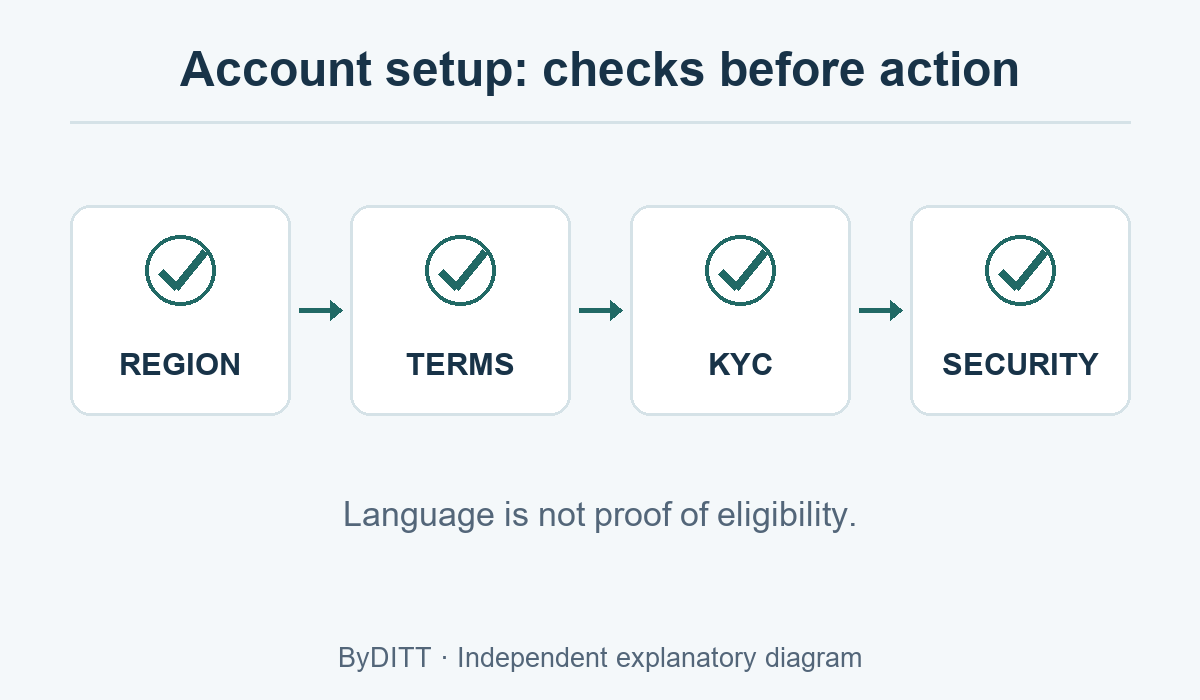
Bybit account setup starts with regional eligibility, current terms, identity verification and security. A page's language does not determine whether you can use the service.
Read the guideView the diagram
Fees
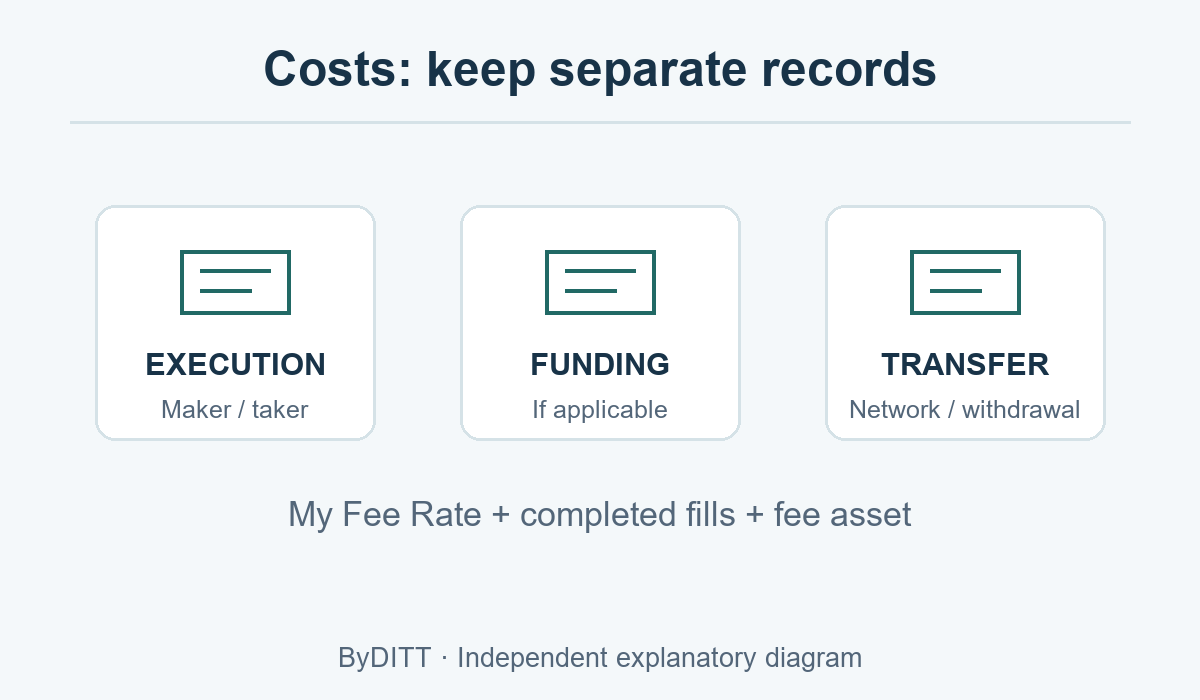
Separate execution fees, funding where applicable, and transfer costs. Compare My Fee Rate with completed fills and the asset in which the fee was charged.
Read the guideView the diagram
Code Conditions
Affiliate, campaign and security codes have different purposes. BYBITDC identifies an affiliate relationship; it does not prove a fixed discount or reward.
Read the guideView the diagram

Deposits
Before a transfer, match the asset, supported network, destination address and memo or tag when required. Check minimum amounts and current charges.
Read the guideView the diagram

Risk
Market, custody, margin and regulatory risks are separate. Account security controls and a lower fee do not eliminate the possibility of loss.
Read the guideView the diagram

Security
Set up Google Authenticator (OTP) and other available security controls before depositing significant funds. Security requirements can differ by action and account.
Read the guide ↗Find a guide for your question
Choose a specific question. Each link opens the corresponding English guide; costs, eligibility and risks depend on the account and product.
Latest guides
View all guidesNewly published guides, ordered by publication date.
How to Buy USDT on Bybit: P2P, Bank Card and Crypto Deposit Costs
Published
Compare the total cost of obtaining USDT through Bybit P2P, an external bank card, third-party payment, fiat balance or an existing crypto deposit. In…
Bybit Card Declined Despite a Balance: Spending Power and Payment Checks
Published
A status-first guide to a declined Bybit Card payment. Distinguish total account value from available Spending Power, check payment settings and limit…
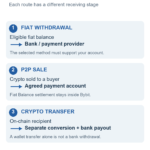
Bybit Bank Withdrawal: Fiat, P2P and Crypto Routes Explained
Published
Compare Bybit fiat withdrawals, P2P payments and crypto-transfer routes to a bank account. Check eligibility, receiving-account conditions, total cost…
Official Bybit Base Fee Reference
| Tier | Spot Taker | Spot Maker | Futures Taker | Futures Maker |
|---|---|---|---|---|
| VIP 0 | 0.1000% | 0.1000% | 0.0550% | 0.0200% |
| VIP 1 | 0.0800% | 0.0675% | 0.0400% | 0.0180% |
Official base rates, checked 2026-10-05. Source: Bybit Trading Fee Structure. Actual fees vary by product, region and VIP level; check My Fee Rate in your account.
Start with Four Checks
Common Questions
Does BYBITDC guarantee a fixed fee discount?
I registered without BYBITDC. Can I add an affiliate code later?
Are Bybit trading fees identical for every user?
Which network should I use to deposit crypto?
Does UTA mean every coin is counted at 100% of market value as collateral?
Guide Overview
1. What BYDITT Is
BYDITT is an independent educational and affiliate website focused on Bybit. It is not Bybit.com and does not operate the exchange. This homepage is designed as a concise starting point for account setup, fee structures, Unified Trading Account concepts, deposits, withdrawals, and derivatives risk.
2. Bybit Products and Limitations
Bybit provides spot trading, perpetual and expiry futures, options, and other trading products. For traders, the useful questions are not permanent ranking claims such as “Top 3,” which can change, but whether the exchange supports the products, liquidity, order types, collateral model, and risk controls required for a particular strategy.
3. Unified Trading Account (UTA)
Bybit’s Unified Trading Account combines multiple trading products in a single account structure. Supported margin assets can be used as collateral in Cross Margin and Portfolio Margin modes, allowing users to access supported products without keeping a separate settlement balance for every position.
However, “unified” does not mean every asset receives 100% of its market value as margin. Bybit applies asset-specific Collateral Value Ratios, and users can choose which supported assets are enabled as collateral. These parameters can change with market and liquidity conditions.
4. Bybit Fees and Referral Code Conditions
Bybit’s official base fee schedule distinguishes Spot taker/maker fees and Perpetual & Futures taker/maker fees. VIP status can reduce base rates, and Bybit notes that actual fees may vary by region. For that reason, the account-specific My Fee Rate page is more authoritative than any static third-party table.
BYBITDC identifies ByDITT’s affiliate link. It does not establish a fixed discount or reward. Any applicable benefit depends on current terms and eligibility; verify the actual fee in My Fee Rate.
5. Deposits and Withdrawals
When transferring crypto to Bybit, network compatibility is the first requirement. The network selected on the sending platform must match the network associated with the Bybit deposit address. Some assets also require a memo, destination tag, or similar identifier.
There is no single blockchain or coin that is always the cheapest transfer method. The sending platform’s withdrawal fee, current network conditions, minimum deposit requirements, and the user’s later trading needs all matter. Users should also review any Travel Rule or identity-matching requirements imposed by the originating platform or jurisdiction.
6. Derivatives Risk Management
Leverage increases exposure relative to posted margin and reduces the room available before liquidation. Before using perpetual or futures contracts, traders should understand Mark Price, liquidation price, margin mode, maintenance margin, funding fees, and position sizing.
Cross Margin, Isolated Margin, and Portfolio Margin distribute account risk differently. A setting that improves collateral efficiency can also expose a larger pool of account equity to losses. Position size and a predefined exit plan generally matter more than using the highest available leverage.
7. Security and Identity Verification
Bybit requires at least Standard individual identity verification for its products and services. Bybit states that KYC generally takes about 15 minutes, while some reviews can take up to 48 hours.
Users should enable the security controls available to their account, protect authentication devices, and verify URLs before logging in. Proof-of-Reserves information can provide additional transparency, but it should not be interpreted as eliminating counterparty, custody, or market risk.
8. Conclusion
Bybit offers a broad set of spot and derivatives tools, while UTA can make multi-asset collateral management more flexible. The important distinction is between structurally documented features and marketing claims that can expire or vary by account.
The code BYBITDC is disclosed for identifying the affiliate relationship, not as a recommendation to register or trade. Assess fees, regional eligibility, liquidation and custody risks independently.
About ByDITT and editorial standards
ByDITT is an independent educational and affiliate website, separate from Bybit.com. Articles are published under the Min Kang byline. This identifies the published author; it is not a claim of financial qualifications or an endorsement by the exchange.
Read editorial details
Our editorial standard is to cite primary documents, state relevant conditions and distinguish illustrative calculations from actual account records or documented tests. A verification date applies to the checked items, not to every claim on the site. Older guides are reviewed individually.
Corrections and contact
For a factual correction, send the page URL, the passage and a supporting official source to contact@byditt.com
Digital assets and leveraged products involve market, custody, payment and regulatory risks. ByDITT may receive affiliate compensation. A referral code does not establish eligibility, a fixed fee reduction or protection from losses.
Official references and verification
Fee table, KYC, regional eligibility, affiliate-code conditions and deposit checks verified: 2026-10-05. Conditions can change; confirm the requirements for your own account and product.
Bybit Account and Fee Checks
Review the displayed terms and account-specific fees. The linked registration page does not establish a guaranteed benefit.