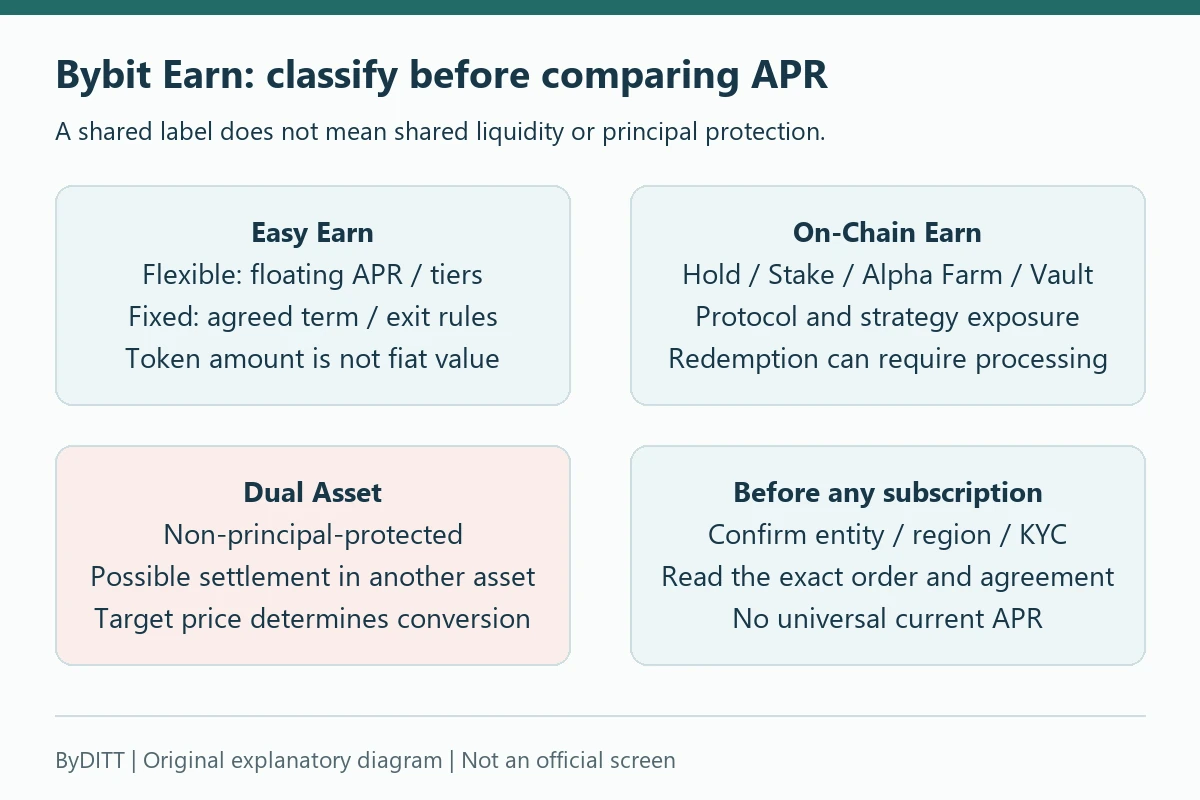
Bybit Earn is a group of products, not one savings account. First identify the product, then compare the yield calculation, exit rule and asset you can receive. A headline APR alone cannot establish the amount you will earn or whether your original asset value is protected.
Last reviewed: 19 October 2026. This existing guide was checked against current official documentation, including the On-Chain Earn introduction updated on 16 October 2026. No account-specific APR, available pool, eligibility or executable quote is claimed. Examples below are independent teaching calculations, not offers or recommendations.
Affiliate and risk disclosure: ByDITT is independent from Bybit. The BYBITDC link is an affiliate link and may compensate ByDITT. It does not increase an Earn APR or guarantee eligibility, principal value, a reward, or profit. Crypto Earn products are not bank deposits. Token prices can fall, products can be locked, and structured or on-chain products can lose value.
Start by identifying the product
| Product family | Typical structure | Main risk to check |
|---|---|---|
| Easy Earn — Flexible | Floating APR, generally redeemable with flexible access | APR changes, token-price risk, tiered limits, redemption timing |
| Easy Earn — Fixed | APR and term set at subscription | Lock-up, limited or unavailable early redemption, token-price risk |
| On-Chain Earn | Hold to Earn, Stake to Earn, Alpha Farm or Vault; product-specific yield | Protocol, validator, smart-contract, slashing, unbonding and liquidity risk |
| Dual Asset | Non-principal-protected structured investment | Settlement in a different asset, target-price outcome, lock-up and opportunity loss |
| Other Advanced Earn products | Product-specific structured terms | Read the individual payoff, settlement asset, loss scenario and cancellation rules |
Do not compare these products only by APR. Two products with the same displayed annualized rate can have very different settlement assets, lock periods, risks, and loss outcomes.
Easy Earn Flexible: floating APR and flexible redemption
The Easy Earn FAQ: product, calculation and Auto-Earn tabs describes floating, potentially tiered Flexible APR and fixed subscription terms for Fixed products. Flexible yield uses effective balances and eligible full hours; newly subscribed funds become effective from the next full hour. Yield is normally credited to Funding at 00:30 UTC the next day, subject to processing delays. Do not treat a pending daily credit as a missing principal withdrawal.
- Check whether the APR is tiered; the rate applied to a small amount may not apply to the entire balance.
- Confirm when a new subscription begins to accrue yield and whether the current hour is excluded.
- Review minimum and maximum amounts, available pool size, and redemption destination.
- Bybit describes Easy Earn principal protection in token amount, not fiat value. This contractual description is not deposit insurance or protection against platform failure, depeg or token-price loss.
Keep a copy of the subscribed tier schedule and the effective balance for the period being checked. A dashboard total is not necessarily the balance that earned yield in every hour. The FAQ also says the redemption hour earns no yield; reconstruct completed hours rather than multiplying from the instant you clicked Subscribe.
Easy Earn Fixed: predictable terms, reduced liquidity
For Fixed Term products, Bybit says the APR and investment duration are fixed at subscription, with principal and yield generally returned at maturity. Some products may allow early redemption, but Bybit’s getting-started guide warns that early redemption can produce a lower APR or no APR. A Fixed Rate Loan supply order may remain locked once filled.
- Save the subscribed asset, APR, term, maturity date, settlement account, and early-redemption rule.
- Check whether rewards are paid in the same asset or multiple assets.
- Review the source of yield shown on the product page, including loan activity or a wealth-management strategy.
- Do not use assets needed for near-term expenses or margin while they are locked.
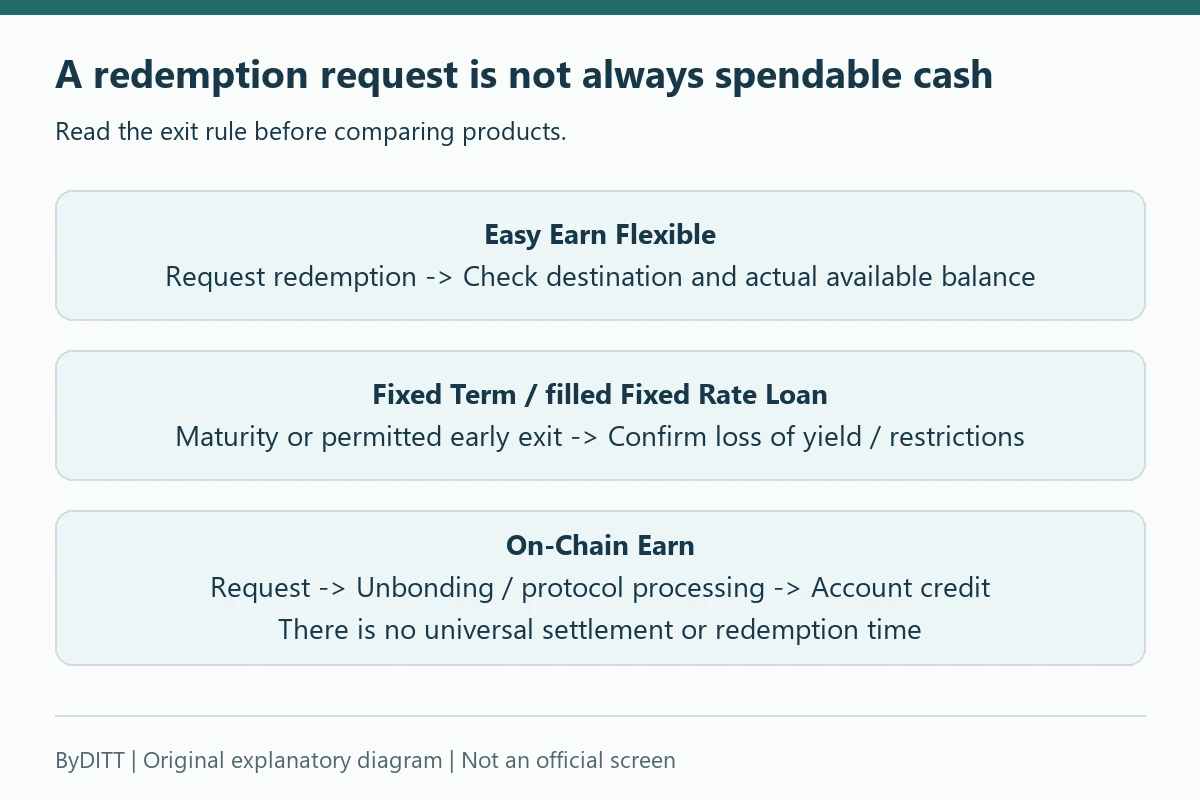
Separate three questions: can a request be submitted, can it be canceled, and when does the credited asset become available? The Easy Earn order, redemption and settings guide distinguishes ordinary Fixed products with possible early exit from a filled Fixed Rate Loan supply order that cannot be redeemed early. Do not promise the same exit rule for both.
On-Chain Earn: protocol risks still exist
The On-Chain Earn introduction now separates Hold to Earn, Stake to Earn, Alpha Farm and Vault. The label therefore covers more than Proof-of-Stake staking. Rewards can arise from a token’s exchange rate or from a protocol strategy rather than a daily cash credit. Strategy, liquidity and technical exposures differ; do not transfer Easy Earn’s token-amount protection statement to these products.
- Identify the underlying protocol and token, not only the Bybit product label.
- Check the bonding and unbonding period, service fee, payout asset, and reward frequency.
- Understand slashing, validator, smart-contract, depeg, and liquid-staking-token risks where relevant.
- Confirm whether the position can be redeemed during market stress.
The On-Chain Earn FAQ explains that a flexible request may still wait for unbonding or protocol processing. Fees can include service, protocol, gas or other processing costs. Successful staking and redemption orders cannot be canceled. Read the specific order before submitting; neither a transferable yield-bearing token nor a request button proves immediate redemption at par.
For a delayed On-Chain credit, record the underlying token, protocol, request ID, status and promised processing window. Compare the redemption exchange rate and net amount, not just the token count shown before unstaking. A reward reflected in an exchange rate will not necessarily appear as a separate daily transfer.
Dual Asset: a structured product, not a savings account
The Dual Asset FAQ identifies Dual Asset as non-principal-protected. It locks the subscribed assets and can change the settlement asset. The settlement reference is the average Bybit Spot price over the 30 minutes before 08:00 UTC on settlement day, not an arbitrary candle or the price when the order was opened.
| Plan | You subscribe with | Possible settlement issue |
|---|---|---|
| Buy Low | Usually a stablecoin such as USDT | You may receive the target crypto after it falls through the target price and continues lower. |
| Sell High | The selected crypto asset | You may receive stablecoin after the asset rises through the target price and continues higher. |
The quoted APR does not eliminate price risk or opportunity loss. Subscribed assets are locked until settlement, returns in asset value are not guaranteed, and Bybit notes slippage tolerance in the settlement process. Use the payoff formula and settlement examples on the current order page before subscribing.
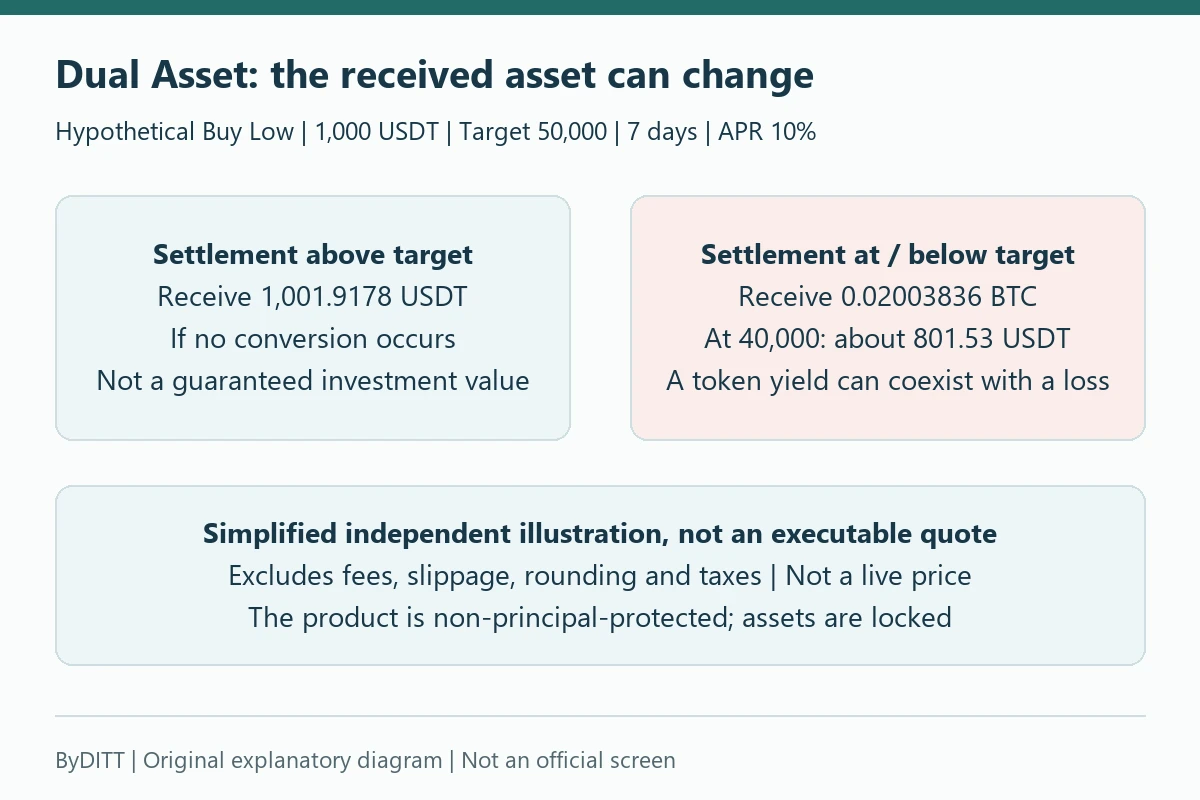
Dual Asset calculation: positive token yield can coexist with a loss
The following is ByDITT’s independent simplified Buy Low example using the Dual Asset settlement formulas settlement structure. Assume 1,000 USDT, a target of 50,000 USDT per BTC, seven days and a constant 10% APR. These are invented inputs, not live rates or a suggested order. Exclude fees, slippage, rounding and taxes; actual settlement can differ.
1,000 × (1 + 0.10 × 7 ÷ 365) = 1,001.917808 USDT is the notional amount before any conversion. If the settlement price is above the target, the simplified result is about 1,001.9178 USDT. At or below target it converts at the target price: 1,001.917808 ÷ 50,000 = 0.02003836 BTC.
If the received BTC is then valued at a hypothetical 40,000 USDT per BTC, its value is about 801.53 USDT, roughly 19.85% below the original 1,000 USDT. The quoted yield did not prevent this loss. Equality matters: Buy Low converts when settlement is at or below target, while Sell High converts when settlement is at or above target. The outcome is not controlled by a mid-term touch of the target.
How to read an APR correctly
APR annualizes a rate; it does not mean the displayed percentage will be earned over a short term. Flexible APR can change, tiered APR may apply only to part of the balance, boosters can be capped, and structured products can settle in another asset.
- Use the effective amount after tier thresholds, not the headline maximum.
- Use the actual number of eligible hours or days.
- Check what is already netted into the rate before subtracting costs. The Easy Earn FAQ says its management fee is already reflected in APR; do not deduct it twice. Other products may have separate fees.
- Convert the final token amount to fiat only as a scenario, not as a guaranteed value.
- Compare the result with holding liquid assets and with the risk-free benchmark available in your jurisdiction.
Worked APR example: a capped high tier changes the result
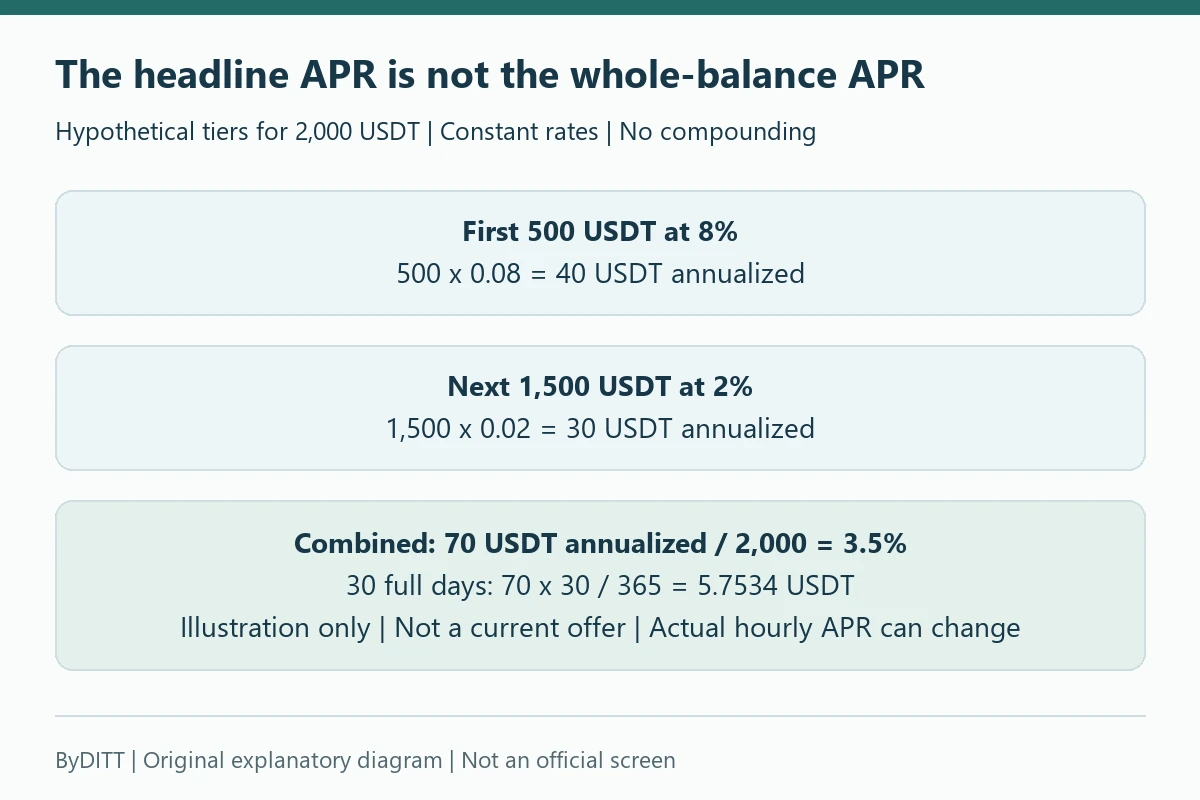
Assume, purely for arithmetic, that the first 500 USDT earns 8% APR and the next 1,500 earns 2%. On a 2,000 USDT balance, the annualized amounts are 500 × 0.08 = 40 USDT and 1,500 × 0.02 = 30 USDT. The weighted APR is (40 + 30) ÷ 2,000 = 3.5%, not 8%.
With the entire balance eligible for 30 complete days and no rate changes or compounding, estimated yield is 70 × 30 ÷ 365 = 5.7534 USDT. Applying the headline 8% to all 2,000 would incorrectly give 13.1507 USDT. The difference, about 7.3973 USDT, comes from ignoring the second tier, not from an unexplained platform fee.
For a 12-hour eligible period at those unchanged hypothetical tiers, the estimate is 70 ÷ 365 ÷ 24 × 12 = 0.0958904 USDT. If a balance or rate changes, calculate each eligible interval separately and add the results. Do not treat all hours as having the opening rate.
These calculations assume an unchanged token price only when discussing token amounts; they do not forecast purchasing power. For example, 1,000 units of a hypothetical token growing by 1% becomes 1,010 units. If its unit price falls from 1.00 to 0.80 in the chosen valuation currency, the final value is 808 rather than 1,000, a 19.2% loss before other costs. A protected token count and a protected fiat value answer different questions.
Auto-Earn and compounding
The Easy Earn order, redemption and settings guide places Easy Earn Auto-Earn at 10:00 UTC daily for supported idle Funding assets. Treat it as a standing instruction, not a one-off action. Check selected coins, limits and whether funds are needed elsewhere. Flexible rewards can be reinvested when Auto-Earn is enabled; Fixed Term does not automatically compound. Reinvestment changes the effective balance, so a simple APR example must not be presented as an APY forecast.
Why a displayed yield or redemption does not match your balance
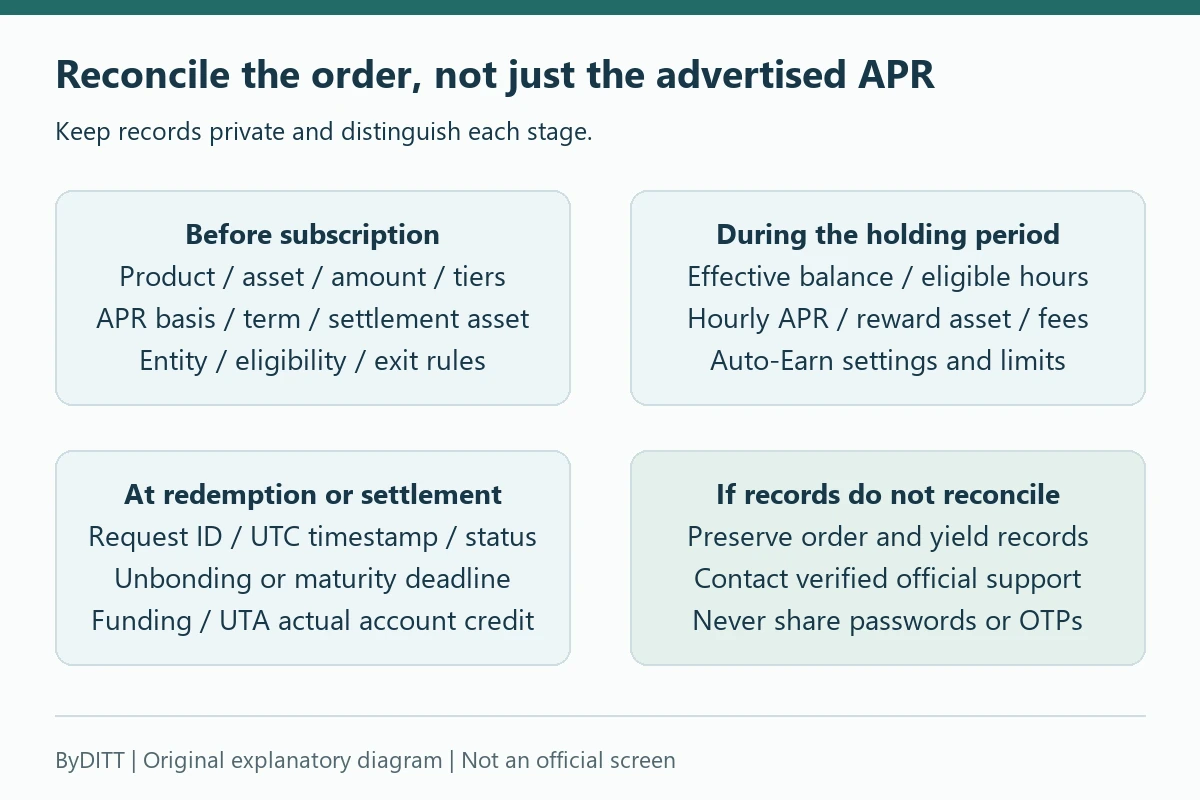
- No yield yet: verify effective time, eligible complete hours and the payout account. Distinguish accrued yield from distributed yield and from an estimate.
- Less yield than expected: reconcile tiers, hourly balance changes, rate changes, reward asset and capped voucher conditions. A reward cap or duration is not an unlimited rate for the whole balance.
- Auto-Earn moved an idle balance: review the enabled assets, maximum limit and order record. Turning a setting off and redeeming an existing holding are different actions.
- On-Chain redemption pending: compare the request time with the protocol’s processing window and status. Do not resubmit because a transfer is not yet spendable.
- Fixed product has no early-exit button: check its contract, maturity and whether a filled loan supply order is involved. Do not infer a universal exit right from another product.
- Dual Asset returned BTC instead of USDT: compare the settlement reference with the target and chosen direction before treating conversion as a missing payment.
- Records still disagree: preserve UTC timestamps, order IDs and the relevant agreement or rate snapshot. Use independently verified official support and redact unrelated balances, personal identifiers and security codes.
The website guide lists Assets → Earn and Orders → Earn Order as record routes; labels can differ by app, entity and release. Check the actual destination account and order status. An Earn redemption is not an on-chain withdrawal: network fees and confirmations belong to a later transfer stage.
Risk checklist before subscribing
- Product: Save the exact product family, asset, term, and agreement.
- Return: Determine whether APR is floating, fixed, tiered, boosted, or only indicative.
- Liquidity: Record lock-up, redemption, unbonding, and settlement times.
- Settlement: Identify the asset you can receive in every scenario.
- Loss: Write down the market, depeg, counterparty, protocol, smart-contract, liquidation, and opportunity-loss cases.
- Eligibility: Confirm KYC, region, account type, limits, and pool availability.
- Security: Use official pages, enable 2FA and anti-phishing controls, and never share a seed phrase or withdrawal code.
Eligibility and risk are product-specific
The official documents do not support one universal KYC rule for every Earn product. The Easy Earn FAQ allows Standard Individual or Business Verification, while the Dual Asset FAQ excludes Business KYC and requires Standard or Advanced Individual KYC. The On-Chain FAQ specifies at least Standard individual verification. Read the exact product’s current eligibility and entity terms; do not generalize one FAQ’s broad wording across all Earn products.
Language is not residence or legal eligibility. A translated page does not establish that the product is available in that reader’s country. Do not use a VPN, inaccurate residency details or another person’s account to bypass restrictions. A product missing from an otherwise valid account may reflect eligibility, capacity or product availability rather than an error.
ByDITT’s risk interpretation: in addition to market and product-mechanism risk, assets held through an exchange remain exposed to custody, operational, counterparty and regulatory risks. A stablecoin can depeg, a protocol can fail, and a redemption can be delayed. No APR, affiliate code or diagram removes those exposures. Compare the consequence of losing access to the asset with the limited estimated yield, rather than treating all Earn choices as cash equivalents.
Related ByDITT reading: account setup and KYC checks; deposit and withdrawal mechanics; security, scam diagnosis and custody risks. These guides answer different questions and do not replace the Earn order terms.
Does BYBITDC change Earn yield?
Do not assume so. An affiliate code and an Earn product are separate. Verify any registration benefit on the Bybit registration screen and any Earn APR on the live product order page. BYBITDC does not override product terms, increase a displayed APR, or remove lock-up and settlement risk.
Short answers to common Bybit Earn questions
- Is Bybit Earn the same as staking? No. Identify Easy Earn, the particular On-Chain category or the structured product first; their mechanisms are not interchangeable.
- Can a high APR offset a price fall? Not necessarily. Compute the term yield, then value every possible settlement asset under adverse price assumptions.
- Is a flexible request immediately withdrawable? Not universally. Inspect processing, destination credit and external withdrawal separately, especially for On-Chain products.
- Which number should I compare? Compare net same-currency outcomes over the same eligible period, alongside the possible loss and access restrictions. A maximum APR without its tier, duration and risk is incomplete.
Official references
- Easy Earn FAQ: product, calculation and Auto-Earn tabs — document updated 2026-06-28; checked 2026-10-19.
- Easy Earn order, redemption and settings guide — document updated 2026-04-08; checked 2026-10-19.
- On-Chain Earn introduction — document updated 2026-10-16; checked 2026-10-19.
- On-Chain Earn FAQ — document updated 2026-09-17; checked 2026-10-19.
- Dual Asset FAQ — document updated 2026-09-17; checked 2026-10-19.
- Dual Asset settlement formulas — document updated 2026-09-17; checked 2026-10-19.
- Earn product comparison — document updated 2026-04-08; checked 2026-10-19.
- Easy Earn agreement gateway — document updated 2025-12-16; checked 2026-10-19.
The Easy Earn agreement gateway links to the currently applicable contract. Its Help Center update date is not proof that an old downloaded agreement is still the applicable version. Use the order’s own terms. The Dual Asset introduction mentions a five-minute credit window, while its FAQ allows up to 30 minutes; this guide does not guarantee the shorter time and prioritizes the actual order status. No account transaction or subscription was performed to prepare this article.
This article is educational and is not investment, tax, or legal advice. Crypto prices and product terms can change rapidly. Review the live order page and applicable terms before every subscription.