A Bybit Spot Grid Bot can show positive Grid Profit while Total P&L is negative because completed trading pairs and the value of tokens still held are different things. A fall in the remaining tokens can outweigh the gains from completed grids. To understand the result, compare the same bot at the same time, include earlier profit withdrawals, and distinguish an estimated asset value from the amount actually received when the bot ends.
Reviewed on November 2, 2026. This guide covers the ordinary Spot Grid Bot, not futures grid, leveraged spot-margin positions or an investment recommendation. Product access and account displays can differ by region and change over time.
Grid Profit, Total P&L and Current P&L: the difference
Read these labels as answers to different questions, not competing estimates of one guaranteed payout. The comparison below follows Bybit’s Spot Grid Bot FAQ and P&L calculation guide.
| Metric | Question it helps answer | What not to assume |
|---|---|---|
| Grid Profit | What have completed grid buy-and-sell pairs contributed? | Positive completed-pair gains do not measure the entire bot’s remaining price exposure. |
| Total P&L | What is the overall result, including the changing value of held tokens and applicable recorded trading costs? | A running valuation is not a final conversion quote or a promise that the same amount can be withdrawn now. |
| Current P&L | What result remains in the bot after accounting for grid profits already withdrawn? | A withdrawal can reduce this display without creating a new trading loss. |
| Grid APR / Total APR | What do the respective observed results look like when expressed as a simple annualized rate? | Neither is a guaranteed yield, an APY promise or a prediction that the past pace continues. |
For a simplified ledger with no additional investment, use Total P&L = net realized grid result + unrealized token P&L. Bybit’s account guide distinguishes Current P&L by subtracting cumulative grid-profit withdrawals. Check how your own display records fees before combining numbers.
Why profitable grids can coexist with a losing bot
Imagine a shop that has earned money on items already sold but still owns inventory whose market value has fallen. The completed sales and the inventory loss can both be real. A grid counter mainly tells you about completed cycles; it does not make unsold inventory immune to a falling market.
For a BTC/USDT bot, BTC is the base token and USDT is the quote token. Bybit’s spot-grid introduction describes how the strategy holds and trades those assets. A USDT-denominated result therefore depends on both the completed transactions and the valuation of remaining BTC. A different quote token changes the unit of measurement; it does not remove price risk.
Do not compare a profitable grid pair from yesterday with a total value captured later and call the difference an accounting error. First align the bot identity, valuation currency, timestamp and cash flows. That check also helps distinguish a genuine unexplained discrepancy from a change in the reference price.
Worked example: positive 12 USDT, but an overall loss of 33 USDT
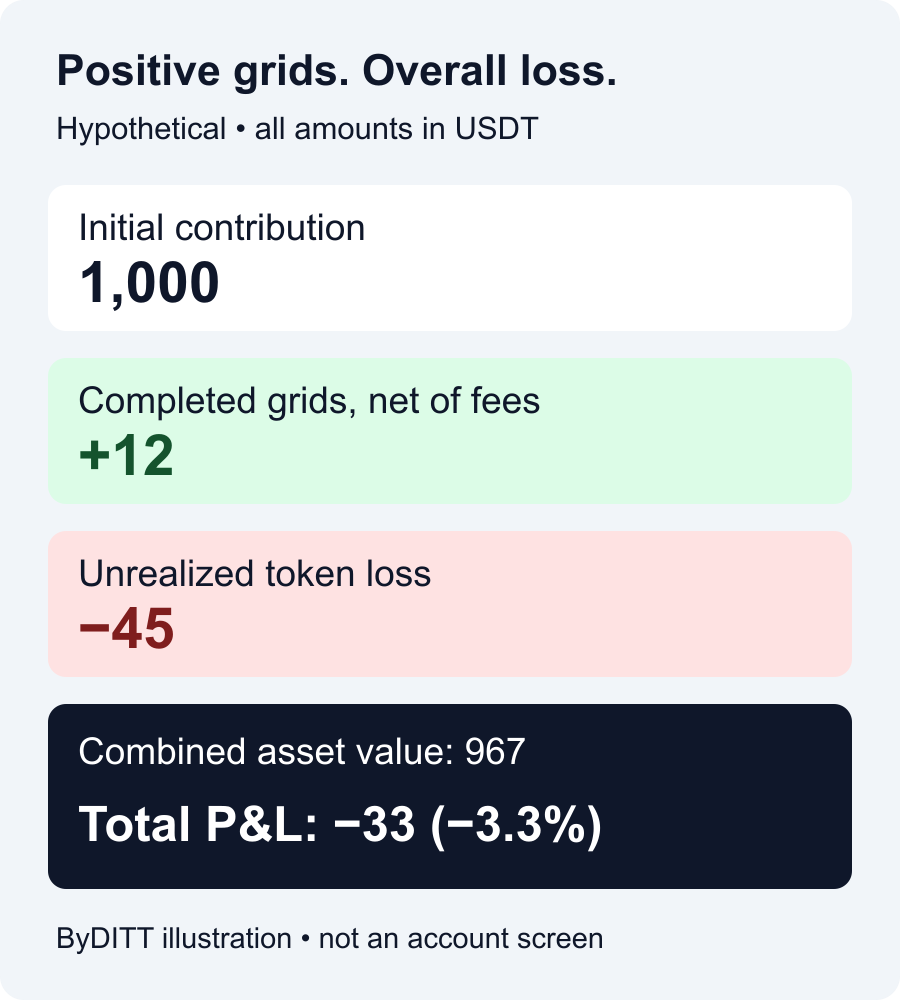
Hypothetical ByDITT example, not an actual account or expected return. The initial contribution is 1,000 USDT. There are no later contributions, no other transfers and no financing or funding charges. The completed grids have generated 15 USDT before 3 USDT of already-recorded trading fees, leaving a net realized result of 12 USDT. Remaining-token valuation is measured at one common snapshot.
| Ledger item | USDT |
|---|---|
| Initial contribution | 1,000 |
| Completed-grid result before recorded fees | +15 |
| Recorded trading fees | −3 |
| Net realized grid result | +12 |
| Unrealized loss on remaining tokens | −45 |
| Total P&L: 12 − 45 | −33 |
| Assets before any withdrawal: 1,000 − 33 | 967 |
The bot has not earned 12 USDT overall. It has earned 12 USDT on the completed portion while another portion is down 45 USDT. The combined result is a 33 USDT loss, or −3.3% of the original contribution. The asset valuation of 967 USDT is not an exit guarantee; a conversion can introduce further trading costs and price differences.
Earlier withdrawals: reconcile remaining assets, not just one counter
Now change the timeline. At an earlier point, the bot has the same net realized gain of 12 USDT but no unrealized loss, so its value is 1,012 USDT. Assume the account’s displayed withdrawable-profit limit then permits a 5 USDT profit withdrawal. The bot retains 1,007 USDT and 5 USDT moves out. Only later does the remaining-token valuation fall by 45 USDT.
This order matters. It does not assume a bot already below its initial contribution will allow another withdrawal. Use the account’s displayed maximum and eligibility; a positive grid counter alone is not permission to withdraw that amount.
At the later snapshot, the bot contains 962 USDT. Add the 5 USDT already withdrawn: 962 + 5 = 967 USDT. Compared with the original 1,000 USDT, the overall result remains −33 USDT. The simplified Current P&L is −38 USDT after the earlier 5 USDT withdrawal; adding that withdrawal back explains the difference from Total P&L.
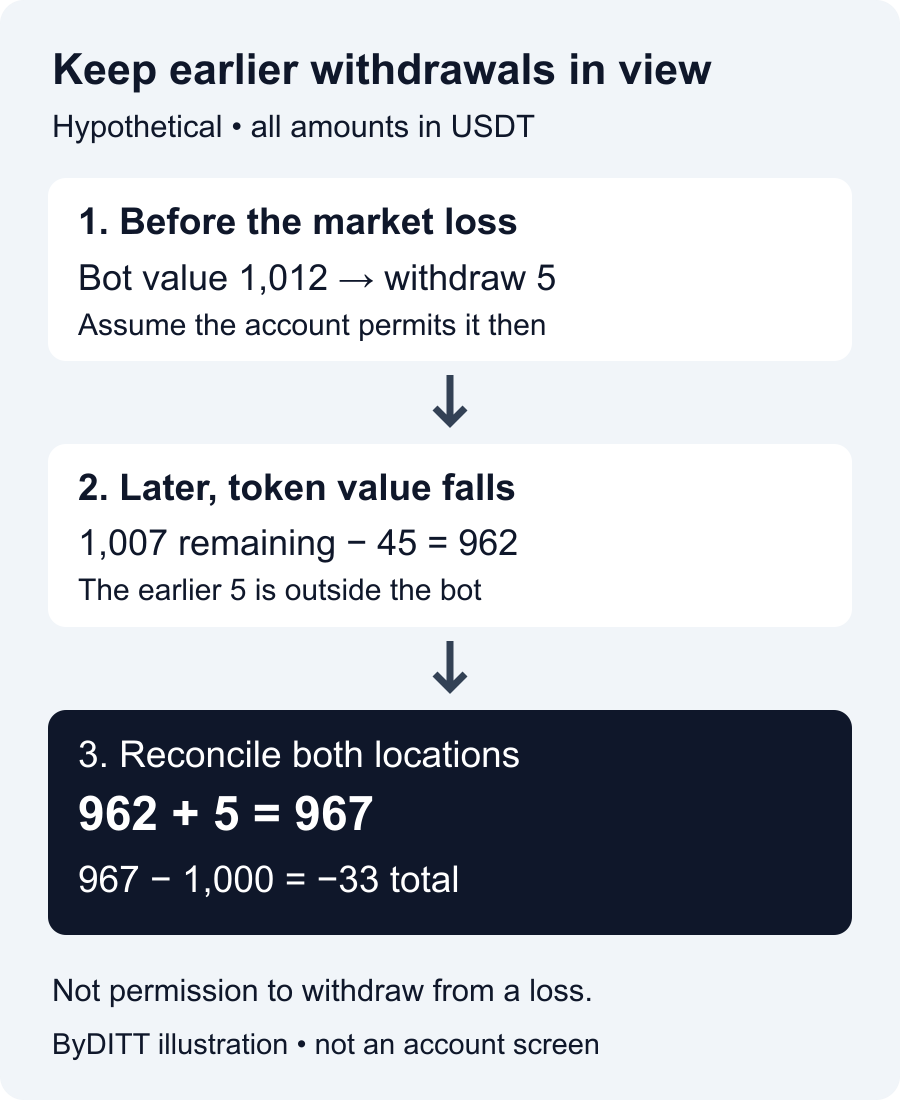
For your own cash-flow check, compare current bot asset value + cumulative withdrawals − cumulative contributions in a consistent currency and at a consistent valuation time. This is a reconciliation identity, not a substitute for the platform’s product-specific methodology. If you add capital, transfer base tokens, modify parameters or combine several bots, record those events separately; the one-contribution example no longer fits unchanged.
Avoid subtracting trading fees twice
The most common arithmetic trap is mixing a gross gain with a net account label. In the example, 15 − 3 = 12 USDT. Once you start from that net 12, deducting the same 3 again would produce a false result of −36 rather than −33 USDT.
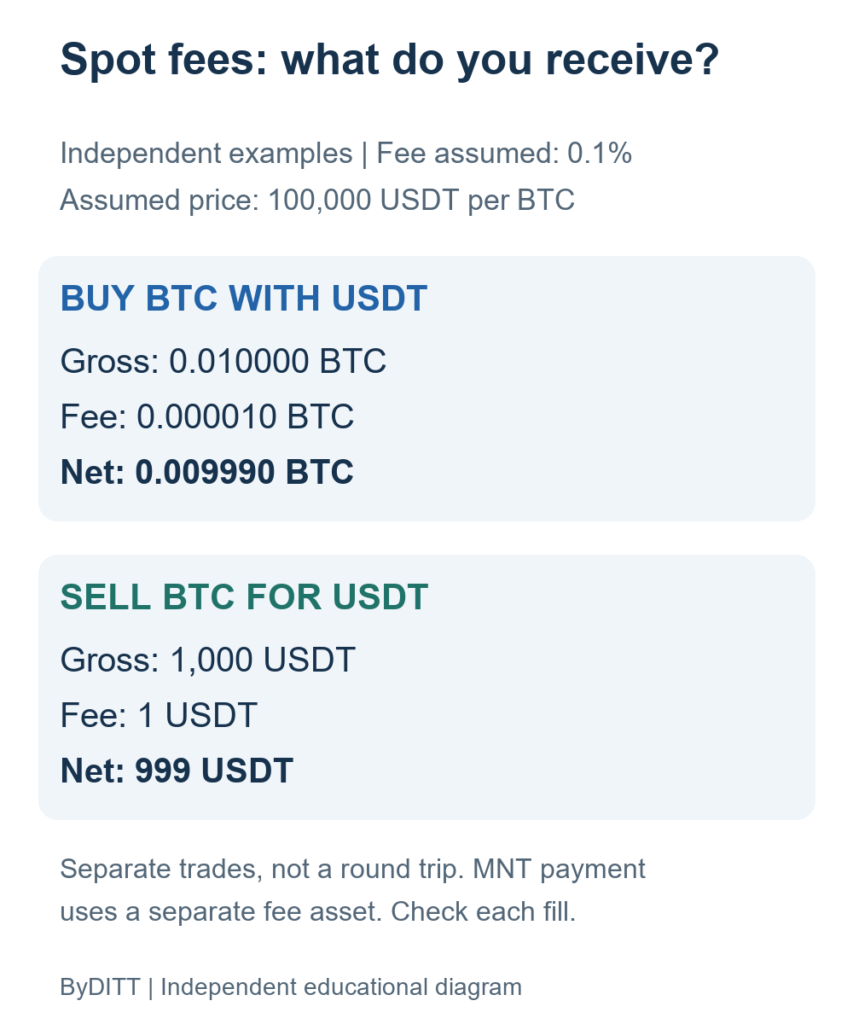
When rebuilding the ledger from fills, record executed quantities, prices, fee amounts and the asset used to pay each fee. A fee taken in the base token can reduce the quantity available for sale. Convert values consistently; do not assume the purchased and subsequently sold quantities are identical.
Bybit’s trading-fee schedule says actual rates can depend on region and directs users to their account’s My Fee Rate page. This article does not assign one fixed rate to every bot or assume a referral benefit. Use our Bybit fee calculator and account-rate guide for a separate cost cross-check, using your verified inputs rather than treating a default as your actual rate.
Why a high Grid APR does not prove that you are ahead
APR scales an observed result to a year; it does not add money to the ledger. For a separate hypothetical 10-day observation with the same 1,000 USDT contribution and 12 USDT net grid gain, a simple calculation gives 12 ÷ 1,000 ÷ 10 × 365 × 100 = 43.8% Grid APR.
If the overall result over those same 10 days is −33 USDT, the corresponding simple annualization is −33 ÷ 1,000 ÷ 10 × 365 × 100 = −120.45% Total APR. The actual observed loss is still 3.3%, not 120.45%. An annualized negative number below −100% is a mechanical extrapolation here, not evidence that this unleveraged example lost more than its starting capital.
Short observation periods amplify both positive and negative annualized figures. Changing capital, valuation conventions and elapsed-time rounding also matter. Do not compare an annualized grid-only figure with a nonannualized whole-bot return, or interpret either extrapolation as a forecast. These calculations are independent examples, not copied performance claims.
Stopping the bot: valuation and actual proceeds can differ
Bybit’s account walkthrough distinguishes keeping both held tokens from converting into the base or quote token when ending a bot. Keeping tokens leaves you exposed to their later prices; conversion changes what you hold and can incur execution costs. Check the available settlement choices for your account.
For an independent illustration, suppose the 962 USDT remaining valuation above becomes 960 USDT of actual proceeds after a hypothetical combined 2 USDT exit-price difference and conversion fee. With the earlier 5 USDT withdrawal, you have received 965 USDT in total, or a 35 USDT loss against the initial contribution. The extra 2 is an assumption, not a Bybit fee quote, and is separate from the 3 USDT already recorded for completed grids.
If you receive a mix of tokens, do not add raw BTC units to USDT units. Record each quantity and either keep the multi-asset record or value both at an explicitly stated reference price. Ending the strategy does not erase a loss already reflected in the assets.
A read-only reconciliation checklist
- Confirm the exact bot, trading pair and whether it is Spot Grid rather than a different bot product.
- Capture the metric labels, valuation currency and timestamp together; note whether the strategy is running or completed.
- Record every contribution and earlier profit withdrawal, without treating your own transfers as new trading gains or losses.
- Compare held base-token quantity, quote-token balance and the valuation price with the overall result.
- Check completed orders and fee records before deciding whether a displayed result is gross or net. Our order and trade history guide explains the separate roles of those records.
- If completed, reconcile the actual returned assets and any conversion fills, not only the value previously shown on the running bot.
- If a difference remains unexplained, keep a concise timeline and submit it through official support. Do not change parameters or place extra trades merely to test an accounting theory.
This is not the same question as Closed P&L for Bybit derivatives. Do not import a futures funding charge, leverage multiplier or liquidation formula into an ordinary spot-grid ledger.
What the numbers do not protect you from
Automation is not principal protection. The token can continue to fall, an inactive or out-of-range strategy can retain price exposure, and quoted valuations can differ from executable prices. Exchange custody, outages, account-access restrictions and regulatory changes remain relevant even when a grid counter is positive. A USDT-denominated example also assumes a common quote-asset valuation; it is not a guarantee of an identical amount of bank-account dollars.
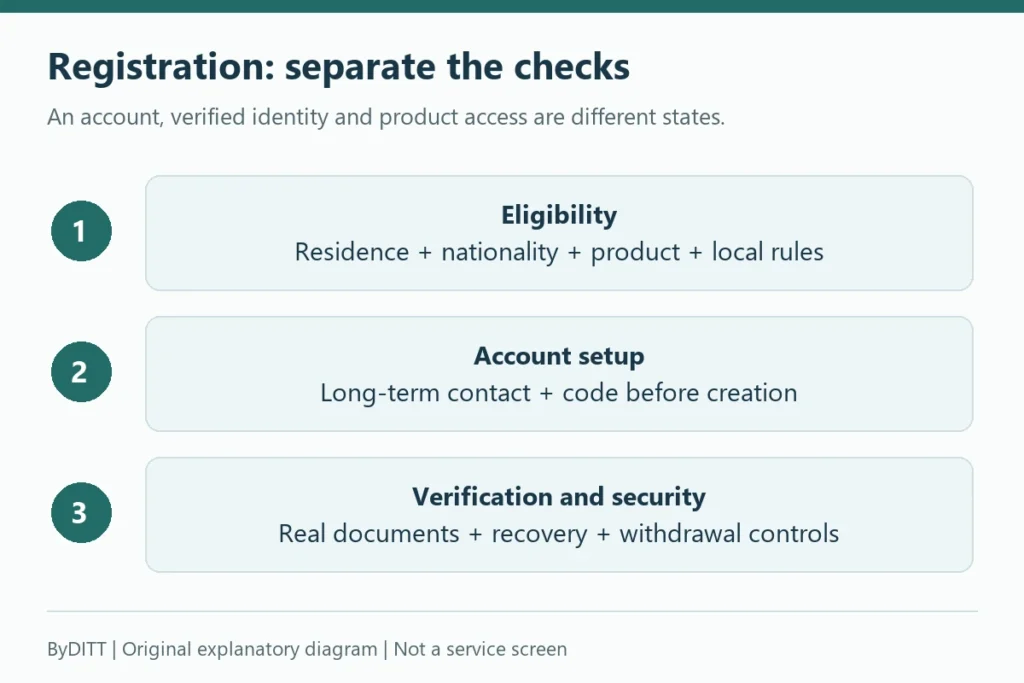
Confirm that the product is available to your account and jurisdiction; do not bypass restrictions. This explanation does not recommend creating a bot, keeping one running or terminating one. It is educational information, not investment, legal or tax advice.
Independent-site disclosure: ByDITT is separate from Bybit.com and may receive affiliate compensation through other links on the site. No registration link or code is required to use this explanation, and no fee reduction, recovery or return is promised here.
Official sources and verification
The following official pages were checked on November 2, 2026. Displayed document-update dates below are not statements that every policy took effect on those dates. Account notices and product terms can change after this review.
- FAQ — Spot Grid Bot — displayed update June 16, 2026; metric distinctions and product limitations.
- P&L Calculations — Spot Grid Bot — September 10, 2026; accounting and annualization definitions.
- Spot Grid Bot account walkthrough — July 13, 2026; account details, withdrawals and settlement choices.
- Trading Fee Structure — September 2, 2026; actual account-rate verification.
- Introduction to Spot Grid Bot — September 10, 2026; base/quote assets and grid mechanics.
ByDITT’s ledgers and two diagrams are original hypothetical teaching material. They do not reproduce a user’s bot, calculate an individual account’s tax result or establish a future return.