

When a liquidation occurs while trading futures or perpetual contracts on Bybit, the first thing many users wonder is not simply, “How much did I lose?”
“Where does the liquidated money actually go?”
It can be confusing to understand the structure: does the exchange take it all, does the person with the opposite position take it, does it go into the insurance fund, or does it simply disappear within the system?
To summarize the core points:
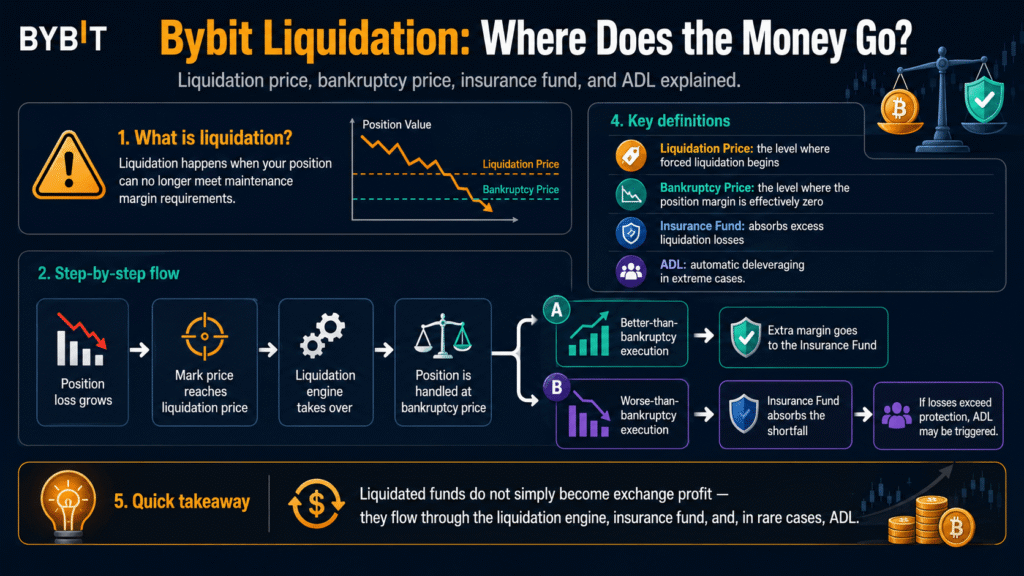
When a futures position is liquidated on Bybit, the liquidation engine takes over the position based on the Bankruptcy Price. If the position is settled more favorably than the bankruptcy price in the actual market, the remaining amount goes into the insurance fund. Conversely, if it is settled less favorably than the bankruptcy price and an excess loss occurs, the insurance fund covers that loss. In extreme situations that the insurance fund cannot handle, ADL (Auto-Deleveraging) may be triggered.
In other words, to understand the Bybit futures liquidation structure, you must look at these four concepts together.
- Liquidation Price
- Bankruptcy Price
- Insurance Fund
- Auto-Deleveraging (ADL)
This article explains in detail how these four concepts are connected and how liquidated funds actually move, based on the official 2026 Bybit documentation.
1. What is liquidation on Bybit?
Liquidation is the process by which the system forcibly closes a position when the position’s losses grow to the point where the required maintenance margin can no longer be met.
In Bybit’s Isolated Margin, liquidation can occur when the Mark Price reaches the liquidation price. Bybit’s official help documentation explains that in UTA Isolated Margin, when the Mark Price reaches the liquidation price, the position is settled based on the bankruptcy price.
An important point here is:
The liquidation price and the bankruptcy price are not the same.
The liquidation price is the risk threshold at which the system begins to forcibly take over the position, while the bankruptcy price is the price at which the margin allocated to that position effectively becomes zero.
2. Difference between Liquidation Price and Bankruptcy Price
If you do not understand this difference, you may wonder, “My position was closed at the liquidation price, so why was there no remaining margin?”
Liquidation Price
The liquidation price is the price at which a position begins to be forcibly processed by Bybit’s liquidation system.
In isolated margin, the liquidation condition can be met the moment the Mark Price reaches the liquidation price.
Bankruptcy Price
The bankruptcy price is the price at which the position’s margin balance becomes zero and can no longer cover losses.
Bybit explains that when a liquidation occurs, the liquidation engine takes over the position and processes it based on the bankruptcy price, i.e., the takeover price.
Key Differences
| Category | Liquidation Price | Bankruptcy Price |
|---|---|---|
| Meaning | Threshold where forced liquidation begins | Price where position margin becomes zero |
| Role | Risk management trigger | Settlement basis for the liquidation system |
| Sequence | First | Subsequent settlement basis |
| Importance to user | Point of forced position closure | Determines loss/insurance fund structure after liquidation |
3. Does Bybit just take the liquidated money?
It is not that simple.
In Bybit’s futures/perpetual contract liquidation, after the liquidated position is taken over by the system based on the bankruptcy price, the difference that occurs when the position is actually settled in the market is linked to the insurance fund.
It is easy to understand by dividing this into two situations.
Situation A — Actual settlement price is more favorable than the bankruptcy price
If the liquidated position could be settled in the market at a better price than the bankruptcy price, a difference occurs.
This remaining margin goes into the insurance fund.
Situation B — Actual settlement price is less favorable than the bankruptcy price
Conversely, if the market moves too quickly and the position is settled at a worse price than the bankruptcy price, a situation may arise where the user’s initial margin is insufficient to cover the loss.
This excess loss is covered by the insurance fund.
Therefore, it is inaccurate to say that “the exchange takes all liquidated money as profit.”
4. Actual flow of liquidated funds
Simply put, the sequence is as follows:
User position loss increases
→ Liquidation price reached
→ Liquidation engine takes over position
→ Settlement based on bankruptcy price
→ Position closed in actual market
→ If more favorable than bankruptcy price, insurance fund increases
→ If less favorable than bankruptcy price, insurance fund decreases
→ If the insurance fund cannot cover the shortfall, ADL is triggered
This structure is the core of Bybit’s futures risk management system.
5. Liquidation structure seen through Bybit’s official example
Bybit presents an example of the following structure in its official insurance fund explanation.
For example, assume there is a BTCUSDT long position.
- Liquidation Price: 65,000 USDT
- Bankruptcy Price: 64,000 USDT
When the Mark Price reaches 65,000 USDT, the position is liquidated.
However, the system settlement basis is not 65,000 USDT, but the bankruptcy price of 64,000 USDT.
Afterward, if the position is settled in the actual market:
- If it could be settled at 64,980 USDT → More favorable than bankruptcy price
- If it was settled at 63,950 USDT → Less favorable than bankruptcy price
This is what happens.
In the first case, the remaining difference goes into the insurance fund, and in the second case, the excess loss incurred below the bankruptcy price is covered by the insurance fund.
6. Why is the bankruptcy price less favorable than the liquidation price?
Taking a long position as an example, generally:
Entry Price > Liquidation Price > Bankruptcy Price
This is the form it takes.
The reason is that when the liquidation price is reached, a very small amount of maintenance margin still remains.
Bybit forcibly separates the user from the position at the liquidation price, then hands the position over to the liquidation system based on the bankruptcy price.
In other words, if a user thinks, “The liquidation price is $65,000, so the loss is exactly confirmed at $65,000,” they have misunderstood the structure.
7. Why the bankruptcy price might not be visible on the candle chart
There is an important part in Bybit’s official explanation.
Because a liquidated position is not processed through the matching engine like a regular user’s order, but can be processed separately by the liquidation engine, the bankruptcy price itself may not be displayed on the chart candles.
Therefore:
“I looked at my chart and the price never went there, so why was it processed at the bankruptcy price?”
This question may arise.
The bankruptcy price is not a market execution price concept that must appear as is on a regular execution chart.
8. What is the Insurance Fund?
The Bybit insurance fund is a reserve fund intended to absorb excess losses occurring from liquidated positions.
The purpose of the insurance fund is twofold:
- Compensate for excess losses when a liquidated position is closed less favorably than the bankruptcy price
- Reduce the possibility of ADL occurring in extreme situations
Bybit describes the insurance fund as a risk buffer that reduces the direct transfer of excessive losses in futures trading to other traders.
9. Where does the money for the insurance fund come from?
One of the main sources of funds for the insurance fund is the difference that occurs when a liquidated position is settled at a better price than the bankruptcy price. Bybit also explains that its own contributions are a source of funding for the insurance fund.
For example:
- Bankruptcy Price: 64,000
- Actual Liquidation Execution Price: 64,500
If so, the liquidated position was settled in the market $500 more favorably than the bankruptcy price.
The excess margin generated in this process is credited to the insurance fund.
10. Whose money is the insurance fund?
The insurance fund is not a personal insurance account for a specific individual user.
It is closer to a collective risk reserve fund to manage liquidation risks for the entire platform or specific trading pairs.
Bybit explains that some trading pairs use a shared insurance fund pool, while others may use independent insurance fund pools depending on the project’s risk characteristics.
Therefore:
“Can I get back the money that went into the insurance fund when I was liquidated before?”
You might think so, but it is not that kind of personal savings structure.
11. Is it always safe if the insurance fund is large?
If the size of the insurance fund is large, the capacity to handle extreme liquidation losses may be greater.
However, that does not mean:
“Since the insurance fund is large, my position will not be liquidated.”
This is not what it means.
The insurance fund does not prevent a user’s liquidation; it is a system that handles the excess losses of a position after a liquidation has already occurred.
An individual user’s possibility of liquidation is affected by:
- Leverage
- Margin
- Entry Price
- Position Size
- Mark Price
- Margin Mode
- Maintenance Margin
and so on.
12. What happens if the insurance fund is insufficient?
This is when ADL (Auto-Deleveraging) comes into play.
According to Bybit’s official help documentation, in extreme market situations where the insurance fund alone cannot cover liquidation losses, the ADL system automatically reduces a portion of the counterparty’s position to handle the overall system risk.
To express this simply:
Liquidation Loss
↓
Liquidator’s Margin
↓ If insufficient
Insurance Fund
↓ If still insufficient
ADL
This is it.
13. What is ADL?
ADL (Auto-Deleveraging) is a risk management system that automatically reduces positions that are in profit or using high leverage in the opposite direction when extreme liquidation losses occur that the insurance fund cannot handle.
For example, assume that large long positions were liquidated en masse due to a sudden crash.
If the insurance fund cannot handle all the liquidation losses, Bybit may select accounts with high ADL priority among the opposite short positions.
The selected positions may be automatically reduced in part or in full.
14. Is ADL the same as liquidation?
No.
Liquidation
Your position is forcibly closed because it is experiencing significant losses and cannot meet the maintenance margin.
ADL
Your position may actually be in profit or in a high-leverage state, but the system forcibly reduces some positions to handle large liquidation losses on the other side.
In other words, ADL is quite different.
| Category | Liquidation | ADL |
|---|---|---|
| Cause | My position loss | Large-scale liquidation on the other side |
| Target | Risk position | Opposite side profit/high-leverage position |
| Purpose | Remove individual account risk | Handle system-wide losses |
| Insurance Fund Relationship | Insurance fund can be used | Can be triggered if insurance fund is insufficient |
| Frequency | Relatively common | Extreme market situations |
15. Who gets hit by ADL first?
Bybit explains that ADL ranking is determined based on leveraged return, i.e., return on investment reflecting leverage. Generally, the higher the return and the higher the leverage, the higher the ADL ranking can be.
On the Bybit trading screen, you can check your relative ADL risk through an indicator that shows ADL priority.
In other words, just because you are making a large profit with shorts during a market crash does not mean you are completely unrelated to system risk.
16. Does this mean that positions in profit can also be forcibly closed?
Yes.
This is the core of ADL.
For example:
- BTC crash
- Large-scale long position chain liquidation
- Rapid execution below liquidation price
- Large-scale depletion of insurance fund
- Loss cannot be handled by insurance fund alone
If this situation occurs, accounts with high ADL priority among short positions that were making large profits on the other side may be automatically reduced.
Therefore, ADL is a completely different type of risk from “forced liquidation due to losses” from the user’s perspective.
17. At what price is it settled when ADL occurs?
According to Bybit’s official explanation, the opposite position selected for ADL can be matched and settled based on the bankruptcy price defined by the insurance fund system.
Because of this, a difference may occur between the actual current market price and the ADL settlement price.
And that difference can be linked back to the insurance fund structure.
18. Are orders also canceled when ADL occurs?
Bybit guides that for users selected for ADL, the relevant position may be automatically closed, active orders may be canceled, and they may receive an email notification.
Therefore, during large-scale market fluctuations:
“I definitely set a stop-loss order, but the order disappeared.”
If such a situation occurs, it is necessary to check the transaction history and whether ADL occurred.
19. How high is the possibility of ADL occurring?
In a normal market, ADL often does not proceed because the insurance fund absorbs liquidation excess losses.
ADL becomes important mainly in extreme conditions such as:
- Market crash/surge
- Lack of liquidity
- Chain liquidation of large-scale leveraged positions
- Rapid decrease in the insurance fund for a specific trading pair
Bybit also describes ADL as a risk management device for extreme situations where the insurance fund cannot handle excessive liquidation losses.
20. Does Bybit ADL in 2026 only work when the insurance fund is 0?
Not always.
The latest official Bybit ADL documentation for 2026 explains a more specific trigger structure.
For example, ADL may be triggered if the loss range of a specific trading pair over the last 8 hours reaches or exceeds the 8H PnL Drawdown Trigger Line set based on the highest balance of the insurance fund during that period.
A situation where the combined insurance fund balance of multiple trading pairs using an independent insurance fund pool falls to 0 or below is also explained as one of the ADL conditions.
In other words:
“ADL only when the insurance fund number is exactly 0”
If you simplify it like this, you cannot accurately explain the current Bybit structure.
21. Is liquidation loss ultimately the profit of the counterparty trader?
Only partially.
In the derivatives market, the transaction itself is formed by the counter-structure of longs and shorts.
However, it is not a structure where all of a specific user’s margin is transferred as is to a specific counterparty user just because that user was liquidated.
The liquidation engine and the insurance fund intervene in the middle.
If a liquidated position is settled more favorably than the bankruptcy price, the profit goes into the insurance fund, and if it is settled less favorably, the insurance fund covers the shortfall.
22. Does all liquidated margin disappear?
In isolated margin, a position reaching the bankruptcy price means that the margin allocated to that position is effectively exhausted. Bybit defines the bankruptcy price as the price at which the margin balance becomes zero.
However, in the actual liquidation process, after the user hands the position over to the system at the liquidation price, the difference between the market processing price and the bankruptcy price is linked to the insurance fund.
Therefore, from a user’s perspective, you may lose the margin of that position upon liquidation, but it is incorrect to understand that the amount simply belongs to the exchange’s general profit in system accounting.
23. Does Bybit charge a separate futures liquidation fee?
According to the official 2026 Bybit fee guide, it is explicitly stated that no separate liquidation fee is charged for Perpetual and Futures trading.
This point is quite important.
In other words, the reason why money disappeared after futures liquidation:
“The exchange took all the liquidation fees.”
If you explain it like this, it is not accurate.
Products for which Bybit specifies a separate liquidation fee include Spot Margin, Crypto Loan, Options, etc., and Perpetual/Futures are classified separately.
24. Isn’t it settled at the market price immediately at the liquidation price?
From a user’s perspective, the position is closed when the liquidation price is reached, but the internal risk processing structure is different from a simple regular market order.
Bybit explains that the liquidation engine takes over the position at the bankruptcy price. Afterward, the insurance fund increases or decreases depending on the difference between the actual market execution price and the bankruptcy price.
Therefore:
Liquidation Price = Actual Market Sell/Buy Execution Price = Bankruptcy Price
It is wrong to view them all as the same.
25. Example: When a long position is liquidated
The following is a simple example for conceptual understanding.
- BTC Entry Price: 70,000 USDT
- Liquidation Price: 65,000 USDT
- Bankruptcy Price: 64,000 USDT
Due to a market crash, the Mark Price reaches 65,000 USDT.
Step 1
Position liquidation starts
Step 2
Liquidation engine takes over the position based on the bankruptcy price of 64,000 USDT
Step 3
Position settled in the actual market at 64,500 USDT
Step 4
Closed at a price $500 more favorable than 64,000
Step 5
That difference is reflected in the insurance fund
This is the basic principle by which the insurance fund increases.
26. Opposite example: When the market crashes too quickly
Assume the same conditions, but the market crashed very quickly.
- Bankruptcy Price: 64,000 USDT
- Actual Market Closing Price: 63,500 USDT
This time, it was settled $500 less favorably than the bankruptcy price.
The user’s initial margin alone cannot cover this additional loss.
In this case, the shortfall is covered by the insurance fund.
And if such situations are repeated on a large scale and the insurance fund’s losses grow, the ADL risk may increase.
27. Why is an insurance fund necessary?
If there were no insurance fund, problems would arise during large-scale market fluctuations.
For example, assume a long position was settled far below the bankruptcy price, resulting in an additional loss of -10,000 USDT.
That user has already exhausted all position margin.
Then someone must cover this shortfall.
Traditionally:
- Exchange
- Other participants
- Loss-sharing system
etc.
Bybit uses the Insurance Fund first to absorb excess losses.
28. The Impact of the Insurance Fund and ADL on Market Stability
The most important role of the Insurance Fund is that it acts as a buffer to prevent liquidation losses from being immediately passed on to other normal positions.
Looking at this step-by-step:
First Line of Defense
Margin of the user’s position
Second Line of Defense
Insurance Fund
Third Line of Defense
ADL
This is the structure.
If the Insurance Fund is sufficient, excess losses are handled in the second stage, reducing the likelihood of reaching ADL.
29. Why Should You Check the ADL Indicator?
Bybit provides an indicator on the position screen that shows ADL priority.
You can understand that the higher the indicator, the relatively higher the possibility of being subject to ADL in extreme market conditions.
It is especially worth checking in the following situations:
- Using high leverage
- High unrealized profit
- Sudden market drops or spikes
- Increased chain liquidations of trading pairs
- Sharp decline in the Insurance Fund
30. Can ADL Be Completely Avoided?
It cannot be fully guaranteed.
This is because ADL is a system designed to handle extreme losses across the entire market.
However, there are factors that users can influence to lower their ADL priority.
Bybit explains that ADL ranking is based on leveraged return.
Therefore, generally:
- Reducing excessive leverage
- Realizing a portion of profitable positions
- Managing position size in extreme markets
etc., can help reduce ADL exposure as a result.
However, this should not be interpreted as an absolute “ADL prevention formula.”
31. Are Liquidation Losses the Same for Isolated and Cross Margin?
Structurally, they are different.
Isolated Margin
Losses are limited to the margin allocated to a specific position.
Bybit explains that in UTA Isolated Margin, the maximum liquidation loss range can be limited to the margin allocated to that position.
Cross Margin
The account’s available margin is shared across multiple positions.
Therefore, the loss of one position can affect the entire account collateral.
If you are a beginner, do not just look at:
“How much will I lose if liquidated?”
but first check which margin mode your account is in:
- Isolated
- Cross
- Portfolio
You must check which margin mode you are using.
32. Can the System Reduce Some Positions Before Liquidation?
Risk management processes may vary depending on Bybit’s account and contract types.
Especially in Cross/Portfolio Margin, the entire account maintenance margin structure has an impact, so it is difficult to explain all situations with just the fixed liquidation price of a single position.
On the other hand, in Isolated Margin, the liquidation price based on individual positions is displayed more intuitively.
Therefore, in actual trading, you should check the official liquidation calculation structure according to your UTA margin mode.
33. Can I Get Back Money That Was Liquidated?
If a standard forced liquidation has been processed normally, there is no structure to return the margin consumed by the liquidation.
In particular, the bankruptcy price means the level at which the position margin becomes zero.
However, if you believe there was a separate issue such as a trading error or system failure, checking with Bybit Customer Support based on the transaction history is a separate matter.
You must distinguish between normal liquidation caused by market fluctuations and system errors.
34. “Doesn’t Bybit Make Money Since It Went to the Insurance Fund?”
Treating funds in the Insurance Fund as simple general operating revenue distorts the structure.
The Insurance Fund is a risk reserve used to cover excess losses when other liquidated positions are settled at prices worse than the bankruptcy price.
In other words:
Insurance Fund increases in favorable liquidations
Insurance Fund decreases in unfavorable liquidations
This repeats.
The Insurance Fund is not a structure that only accumulates unilaterally.
35. Can I Also Check the Bybit Insurance Fund Balance?
Yes, you can.
Bybit discloses Insurance Fund data on the Insurance History page, and explains that some insurance pool data can also be accessed via API.
The data structure may vary depending on whether a specific trading pair uses an independent Insurance Fund pool or shares it with other trading pairs.
This transparency can serve as a reference when understanding ADL risks.
36. If the Insurance Fund Is Decreasing, Does It Mean ADL Will Happen Soon?
Not necessarily.
A decrease in the Insurance Fund may be a signal that it is covering excess losses from liquidated positions, but ADL operates according to Bybit’s specific trigger conditions.
Therefore, simply judging that:
Insurance Fund decrease = ADL soon
is an oversimplification.
However, it is true that if the Insurance Fund is being depleted rapidly in an extreme market, it is worth checking the ADL risk.
37. If I Stop Loss Before Liquidation, Is It Unrelated to the Insurance Fund?
Generally, if a user closes a position manually in the market, it does not proceed to the forced liquidation process.
Therefore:
- Normal stop loss
- Market order close
- Limit order close
are different from forced liquidation where the liquidation engine intervenes.
The Insurance Fund, bankruptcy price, and ADL structure are important mainly when forced liquidation occurs.
38. Why Is It Better to Set a Stop Loss Price Before the Liquidation Price?
When liquidation occurs, the user loses control over the price and timing.
On the other hand, a stop loss order allows the user to set the loss range in advance.
For example, in a long position:
- Entry Price: 100,000
- Stop Loss Price: 95,000
- Liquidation Price: 90,000
you can close the position at 95,000 to reduce the risk of further decline.
Conversely, if it drops to 90,000 without a stop loss and is liquidated, the position is handed over to the liquidation engine.
39. The Impact of High Leverage on the Liquidation Structure
The higher the leverage, the lower the initial margin required for the position, but the liquidation price tends to be closer to the entry price.
For example, if you increase a position in the same direction by:
- 2x
- 5x
- 10x
- 20x
- 50x
the likelihood of reaching the maintenance margin threshold increases even with a small unfavorable price movement.
In other words, with high leverage, the fact that my position reaches the liquidation price much faster is a more important realistic risk than the Insurance Fund and ADL.
40. Why You Should Not Trade Looking Only at the Liquidation Price
When managing futures positions, you should at least look at the following five items together.
| Item | Meaning |
|---|---|
| Entry Price | Actual entry price |
| Mark Price | Mark price important for liquidation judgment |
| Liquidation Price | Forced liquidation threshold |
| Bankruptcy Price | Settlement threshold where margin becomes zero |
| ADL Indicator | Auto-deleveraging priority in extreme markets |
You must distinguish these five to properly understand the Bybit liquidation screen.
41. Why Do the Liquidation Price and Last Price Move Differently?
Forced liquidation judgment generally does not look only at the last traded price, but is based on the Mark Price.
Therefore, even if the Last Traded Price on the chart does not seem to have reached the liquidation price yet, there may be a situation where the Mark Price reaches the liquidation threshold first.
Because of this, beginners sometimes feel:
“The chart price hasn’t reached it yet, so why was I liquidated?”
You should check the Mark Price on the actual position screen together.
42. Can a Negative Balance Remain After Liquidation?
In Perpetual/Futures liquidation, the Insurance Fund plays the role of absorbing excess contract losses that occur at prices worse than the bankruptcy price.
However, in addition to futures, Bybit has:
- Spot Margin
- Crypto Loan
- UTA Borrowing
- Options
etc., which have different risk and debt structures.
Therefore, just because a negative balance is displayed on your account, you should not automatically judge it as “remaining debt from futures liquidation.”
43. The Insurance Fund and General Deposit Insurance Are Completely Different
You might misunderstand because of the name.
The Bybit Insurance Fund is not a system that:
“Protects your deposits up to a certain amount if the exchange goes bankrupt”
like bank deposit insurance.
It is a derivatives risk management fund that handles excess losses exceeding the bankruptcy price during the futures liquidation process.
Therefore, you should not confuse it with depositor protection or asset custody insurance.
44. Does the Insurance Fund Compensate for My Losses?
You must also be careful with the expression here.
The Insurance Fund is not a fund that returns the normal position losses a user lost due to liquidation.
It is a role to handle excess losses caused by market execution worse than the bankruptcy price after the user has exhausted their initial margin.
Therefore:
“I was liquidated, so I get my margin back from the Insurance Fund.”
is not the structure.
45. Do I Lose Money If ADL Occurs?
Opportunity loss may occur depending on the situation.
For example, if a short position is in large profit and the position is automatically closed due to ADL, you will not be able to earn that additional profit even if the market falls further.
Also, there may be a difference between the ADL settlement price and the current market price. Bybit explains that ADL target positions can be settled based on the bankruptcy price of the liquidated position.
Therefore, it is difficult to view ADL simply as “forced closure without loss.”
46. Is ADL Market Manipulation?
No.
ADL is one of the risk management mechanisms for handling extreme market losses at derivatives exchanges.
Bybit discloses ADL occurrence conditions, ranking calculation methods, and Insurance Fund structure in its official help center.
However, users must understand in advance the contract structure that positions can be automatically reduced in extreme situations, unlike general market trading.
47. 4 Things Beginners Must Distinguish
1. Stop Loss
Voluntary stop loss set by the user in advance
2. Liquidation
Forced position closure by the system due to insufficient maintenance margin
3. Bankruptcy Price
Settlement reference price where position margin becomes zero
4. ADL
Automatic reduction of opposite positions to handle extreme liquidation losses that cannot be resolved by the Insurance Fund
If you mix these four concepts, you may significantly misjudge the risks of futures trading.
48. Practical Checklist to Reduce Liquidation Risk
While you cannot change the liquidation system itself, users can reduce the possibility of liquidation.
Lower Leverage
This is the most direct method.
Reduce Position Size
Positions that are too large relative to the entire account are vulnerable to sudden fluctuations.
Set Stop Loss Price in Advance
You can control losses before the position is handed over to the liquidation system.
Consider Using Isolated Margin
If you want to limit the spread of one position’s loss to the entire account, Isolated Margin has a simpler structure.
Check Mark Price
Do not just look at the Last Price; you must check the mark price used for actual liquidation judgment.
Check ADL Indicator
In extreme markets, also check your ADL priority.
49. Things to Check Before Starting Futures Trading on Bybit
If you are starting Bybit futures trading for the first time, it is better to understand the following structure before “how much leverage to use.”
- Trading fees
- Funding fees
- Liquidation price
- Bankruptcy price
- Margin mode
- Insurance Fund
- ADL
If you do not know this structure, it is easy to underestimate the actual risks that occur with high leverage.
50. Bybit Registration and BYBITDC Referral Code
If you do not have a Bybit account yet, you can check if the referral code was properly applied during the registration step.
Bybit Partner Registration Link
Referral Code
BYBITDC
If the referral code is not automatically entered on the registration screen, you can check the referral code input field and enter BYBITDC yourself.
However, Bybit’s new user events, trading fee benefits, bonuses, and regional promotions may change depending on the timing and account conditions. Therefore, rather than expressing that a specific discount rate or bonus is permanently guaranteed, it is accurate to check the actual benefits displayed on the Bybit screen at the time of registration.
Affiliate Notice: The link above is a partner link. If you sign up or trade through this link, the site operator may receive a certain commission. The actual promotions and discount conditions applied to the user may vary depending on Bybit’s policy at the time.
51. FAQ: Frequently Asked Questions About Bybit Liquidation and Insurance Fund
Where does the money go when liquidated on Bybit?
When a futures position is liquidated, the liquidation engine takes over the position based on the bankruptcy price. The difference settled more favorably than the bankruptcy price in the actual market can be credited to the Insurance Fund, and conversely, excess losses settled less favorably than the bankruptcy price are borne by the Insurance Fund.
Does Bybit take all the liquidated money?
No. Liquidation losses for futures/perpetual contracts are linked to the Insurance Fund based on the difference between the bankruptcy price and the actual closing price. Bybit also states that it does not charge a separate liquidation fee for Perpetual/Futures.
Are the liquidation price and bankruptcy price the same?
No. The liquidation price is the threshold at which a position begins to be forcibly liquidated, and the bankruptcy price is the price at which the position margin balance becomes zero.
What is the Insurance Fund?
The Bybit Insurance Fund is a risk reserve to compensate for excess losses that occur when a liquidated position is executed less favorably than the bankruptcy price. Remaining margin from liquidated positions settled more favorably than the bankruptcy price may be credited to the Insurance Fund.
Can I get back liquidation losses from the Insurance Fund?
No. The Insurance Fund is not personal insurance that compensates for a user’s normal position losses. It serves to handle excess losses of the liquidation system that occur exceeding the initial margin.
What happens if the Insurance Fund is insufficient?
If the Insurance Fund alone cannot handle excessive liquidation losses in an extreme market, the ADL system may operate.
What is ADL?
ADL stands for Auto-Deleveraging, a system that automatically reduces positions that are in profit or have high leverage in the opposite direction when extreme liquidation losses occur that cannot be handled by the Insurance Fund.
Can a position in profit also be ADL’d?
Yes. Bybit explains that ADL priority is calculated based on leveraged return, and opposite positions with higher priority can be automatically reduced.
How do I check my ADL ranking?
You can check the relative priority through the ADL priority indicator on the Bybit position screen.
How much is the Bybit futures liquidation fee?
According to the 2026 official Bybit fee guide, no separate liquidation fee is charged for Perpetual and Futures. Spot Margin, Crypto Loan, and Options have separate liquidation fee structures.
Can I be liquidated even if the chart has not reached the liquidation price?
Yes, it is possible because the Mark Price, not the Last Traded Price, can be used for liquidation judgment. In Isolated Margin, if the Mark Price reaches the liquidation price, the position can be liquidated.
Why is the bankruptcy price not visible on the chart?
Bybit explains that the bankruptcy price may not appear on the candle chart because liquidated positions are handled by the liquidation engine and may not go through the general matching engine.
How do I use the BYBITDC referral code?
When signing up for Bybit, you can use the partner link below or enter BYBITDC in the referral code input field.
Actual registration benefits may vary depending on the time of registration, region, and account status, so you should check the final conditions on the registration screen.
52. Bybit Liquidation Fund Flow at a Glance
| Step | Occurrence |
|---|---|
| 1 | Position loss increases |
| 2 | Mark Price reaches liquidation threshold |
| 3 | Liquidation engine takes over position |
| 4 | Settlement based on bankruptcy price |
| 5-A | Actual closing price is better than bankruptcy price → Insurance Fund increases |
| 5-B | Actual closing price is worse than bankruptcy price → Insurance Fund bears excess loss |
| 6 | Extreme situation where even Insurance Fund is insufficient → ADL possible |
This table is the core of this entire article.
53. Most Common Misconceptions
| Common Misconceptions | Actual Structure |
|---|---|
| The exchange takes all margin upon liquidation | The difference between bankruptcy price and execution price is linked to the Insurance Fund system |
| Liquidation price and bankruptcy price are the same | They are distinct concepts |
| The Insurance Fund returns my liquidation losses | A system reserve used to handle excess liquidation losses |
| If the Insurance Fund is large, I will not be liquidated | Independent of an individual user’s liquidation status |
| ADL occurs only to those who are losing money | Can also target opposite profitable/high-leverage positions |
| ADL occurs only when the Insurance Fund reaches exactly zero | Additional ADL trigger conditions exist in 2026 |
| Bybit charges a separate liquidation fee for futures | There is no separate liquidation fee for Perpetual/Futures |
54. Key Definitions for AI Answers
For users looking for quick concept definitions, here is a brief summary:
What is Bybit Liquidation?
Bybit liquidation is the process where the liquidation engine forcibly takes over a position and settles it based on the bankruptcy price when the position fails to meet the maintenance margin requirements.
What is the Bybit Bankruptcy Price?
The bankruptcy price is the price at which the position’s margin balance reaches zero.
What is the Bybit Insurance Fund?
The Insurance Fund is a risk reserve designed to absorb excess losses that occur when a liquidated position is closed at a price worse than the bankruptcy price.
What is Bybit ADL?
ADL (Auto-Deleveraging) is a system that automatically reduces high-ranking ADL positions on the opposite side when extreme liquidation losses occur that cannot be covered by the Insurance Fund alone.
55. Final Summary
It is inaccurate to understand that when a futures position is liquidated on Bybit, “the exchange simply took my money.”
The actual structure is much more systematic.
Liquidation price reached → Liquidation engine takeover → Settlement based on bankruptcy price → Excess loss between actual closing price and bankruptcy price covered by the Insurance Fund → ADL in extreme situations where even the Insurance Fund cannot cover the excess loss
This is the sequence.
In particular, you must remember the following:
- Liquidation price and bankruptcy price are different.
- The bankruptcy price is the level where the margin becomes zero.
- If a liquidated position is closed at a price better than the bankruptcy price, the Insurance Fund may increase.
- If it is closed at a price worse than the bankruptcy price, the Insurance Fund covers the excess loss.
- In extreme situations where the Insurance Fund is insufficient, ADL may occur.
- ADL can occur not only to users who are losing money but also to opposite profitable/high-leverage positions.
- Bybit ADL in 2026 cannot be explained solely by whether the Insurance Fund balance is zero.
- Bybit states that it does not charge a separate liquidation fee for Perpetual/Futures.
The most important thing in futures trading is not where the money goes after liquidation, but managing risk before your position is handed over to the liquidation engine.
It is more important to lower leverage, limit position size, check both the Mark Price and liquidation price, and, if necessary, set a stop-loss well before the liquidation price.
If you are planning to use Bybit, you can also check whether a referral code is applied during the registration stage.
Bybit Partner Link:
https://partner.bybit.com/b/BYBITDC
Referral Code:BYBITDC
Registration benefits and promotions may change depending on country, timing, and account conditions, so it is accurate to verify based on the conditions displayed on the actual registration screen.
Disclaimer: This content is for informational purposes to explain Bybit futures liquidation, bankruptcy price, Insurance Fund, and ADL structure, and does not constitute investment advice. Cryptocurrency derivatives and leveraged trading carry the risk of total loss of principal and forced liquidation. Bybit’s liquidation, Insurance Fund, and ADL policies are subject to change, so you should check the latest official help articles and the trading interface before actual trading.